A Retiring Japanese Chef Picked Up My Plastic Cutting Board, Held It To The Light, And Asked Me: “Where Do You Think The Plastic Went?”
I have chopped every family dinner on a plastic board for forty years. It took a 74-year-old chef’s farewell cooking class to show me what my knife had been shaving into our food.


Since 1985 I have cooked dinner for my family almost every night. Three kids, now five grandkids, and a husband, Ron, who still thinks a meal isn’t a meal unless something got chopped for it. I cook from scratch. I buy my vegetables at the Second Street Market on Saturdays. I would have told you I was one of the careful ones.
So I want to tell you what happened at Morita’s this summer, because it changed something in my kitchen that I had not thought about once in forty years.
The last eight Saturdays at Morita’s
If you’ve lived in Dayton any length of time you know Morita’s. It’s a twelve-table Japanese place on Brown Street that Chef Kenji Morita opened in 1985, the same year Ron and I got married. We went every anniversary for thirty years. In August a sign went up in the window: after forty-one years, Chef was retiring and the restaurant would close at the end of September.
For his last eight Saturdays he ran a knife class for regulars in the restaurant kitchen. Forty dollars, two hours, bring your own knife and your own cutting board from home. My friend Carol and I signed up the day it was announced.
So on the first Saturday I wrapped my good chef’s knife in a dish towel and put my cutting board in a tote bag. A white plastic one, the big kind from Target. I’d had it maybe two years. It looked like every cutting board in every kitchen in America.
He picked up my board and held it to the light
Chef walked the prep table while we practised on cucumbers. He stopped behind me, watched for a second, and then, without saying anything, slid my cutting board out from under my vegetables and tilted it up under the fluorescent light.
The whole surface lit up. Hundreds of fine white lines, criss-crossing every which way. Grey stains down in the deeper ones. Little curls of white standing up out of the cuts like lint.
“Every line is a place your knife took plastic off this board,” he said. “Where do you think the plastic went?”
I said something like, down the sink, I suppose.
He shook his head and set it back down very gently. “Some. The rest went into the food. Then into the family.”
“You wash the board. You cannot wash the plastic back into it.”
Chef Kenji Morita, August 2026
Then he told the class something I haven’t been able to forget. For thirty-five years he cut on a traditional hinoki wood board. Six years ago his grandson, who studies food science in Osaka, put a swab from the knife marks of that board under a microscope and showed him what was living down in the grain. Chef threw the board away that week. He hasn’t cut on wood or plastic since.
Then he reached under the counter and put his own board on the table. Thin. Grey. Metal, but much too light to be steel. He laid a raw chicken thigh on it, cut it, rinsed the board under the tap for two seconds and handed it to me. It was clean. Not a mark on it, after six years in a restaurant kitchen.
“Titanium,” he said. “Nothing comes off it, and nothing goes into it.”
What I found at the kitchen table that night
I’ll be honest, I was a little offended on the drive home. I’ve been cooking since before some of those students were born. But I got my iPad out after Ron went to bed, and within ten minutes I found the study that made my stomach turn over.
That is how much a single plastic cutting board can shed into the food chopped on it, according to researchers at North Dakota State University. By weight it works out to as much as 50 grams of plastic a year, ground into the vegetables, meat and bread you serve.
A single chopping session on a plastic board released thousands of particles straight into the food. The board doesn’t look like it’s wearing away, because it happens one invisible flake at a time. It looks exactly like my board looked under Chef’s light.
And then I found the follow-up. In 2025, researchers in China fed mice food that had been chopped on plastic cutting boards for twelve weeks. The mice developed inflammation in the gut lining and changes in their gut bacteria. Other studies have found microplastics in human blood, in the liver, and in the arteries of people with heart disease.
I don’t know about you, but at sixty-three I already have a stomach that complains and knees that ache in the morning. I’d always put it down to getting older. Sitting there at eleven at night, I couldn’t stop wondering how much of it I had chopped into my own dinner, a little at a time, for forty years.

Then there are the germs. The deep knife grooves in a plastic board are exactly where raw chicken juice ends up. Food safety guidance says a scarred plastic board should be thrown out, because those grooves can’t be fully scrubbed or sanitised. Mine had two years of grooves in it. I had been cutting salad on it after chicken, with a quick wash in between, for my grandchildren.
Try this in your own kitchen tonight
- Hold your cutting board at an angle under the brightest light in the kitchen.
- Count how many lines you can see in one square inch.
- Run a fingernail across it. If it catches, the plastic in that groove is already gone. It went into your food.
Why I didn’t just buy a wooden one
My first thought was to grab a nice heavy wood board at the store and be done with it. Then I remembered Chef’s hinoki board and the microscope. Wood is porous. Raw meat juice and moisture soak down into the grain where no sponge can reach, and the knife grooves fill up with it. Wood boards need oiling every month or they crack and grow mould. Bamboo has the same problem, and most bamboo boards are held together with glue.
Glass is worse in a different way. The knife skates on it, and it ruins a blade in a week. Stainless steel dulls knives too, and it clangs.
| Plastic | Wood / bamboo | Glass | Titanium | |
|---|---|---|---|---|
| Sheds into food | Up to 50g of plastic a year | Splinters and fibres | No | Nothing to shed |
| Germs in grooves | Yes, can’t be scrubbed out | Soaks into the grain | No | Non-porous, rinses clean |
| Your knives | Fine | Fine | Dulls them fast | Stays sharp |
| Smells & stains | Garlic, beets, turmeric | Absorbs everything | No | Nothing sticks |
| How long it lasts | Replace every year | Warps and cracks | Chips | For life |
What Chef told us about titanium the next Saturday
I went back the next week with a list of questions. Chef was patient with me.
Nothing comes off it. Titanium is a solid metal. There is no plastic in it to flake off into your food, no coating, no glue. It’s the same metal surgeons use for hip replacements because the body leaves it alone.
Nothing gets into it. There is no grain and no pore for chicken juice or bacteria to hide in. Rinse it under the tap and it’s clean. Titanium also forms a thin oxide layer on its surface that researchers have found works against E. coli and staph.
It keeps your knives sharp. This surprised me most. Titanium is softer than the hardened steel in a good kitchen knife, so the edge doesn’t grind against it the way it does on glass or steel. Chef has cut on his for six years and sharpens less than he did on wood.
It lasts for good. It doesn’t warp, crack, stain or rust. Chef said it’s the last cutting board he will ever buy, which at seventy-four is a joke he enjoyed making more than once.

“Not the cheap grey ones”
At the end of the class I asked him where he got his. He wrote it on the back of the class sign-up sheet for me: Kiru. A small company that makes them out of solid food-grade titanium, double-sided, with a juice groove all the way round.
Then he tapped the paper and said something I’ve since found out is very good advice. A lot of the “titanium” boards you see advertised are really stainless steel with a grey finish, and they clang, dull your knives and rust at the edges. “If it is heavy, it is not titanium,” he said. “Buy the real one once.”
I ordered that night. It arrived in about a week.
Opens Kiru’s own page · Check today’s price and stock
Four months later

The first thing I noticed was how light it is. I’d expected a heavy metal tray, and it’s lighter than my old plastic one. I use one side for raw meat and the other for vegetables, so there’s no more juggling two boards or washing in between.
My knives are sharper. I used to take my chef’s knife to the sharpening man at the market every couple of months. I haven’t been back since July.
Nothing smells. I cut garlic, onions and salmon on it all week. A rinse and it smells of nothing. My plastic board used to smell of onion for days.
It still looks brand new. Not a scratch on it after four months of dinner every night. I’ve tilted it under the light over the sink more times than I’d like to admit. Nothing.

And I know what my family’s food is touching. That’s the real one. When my granddaughter Lily stands on the step stool and “helps” me cut strawberries, she’s cutting on solid metal that doesn’t give anything to the food. I can’t undo the forty years. I can stop adding to them.
“I threw out a plastic board about every year for forty years. This is the first one I’ll never have to replace.”
Diane, October 2026
What about the price?
I won’t pretend a titanium board costs the same as the plastic one from Target. But I added it up. Forty years of replacing a plastic board, plus the knife sharpening, comes to well over five hundred dollars, and I’d still be cutting on plastic.
Kiru is running an early Black Friday sale right now. A single board is $49.00 instead of $98.00, and it’s less per board again if you buy two or three. I bought a second one for my daughter in Columbus, which is cheaper than getting two separately.
They also give you a full money-back guarantee, so if it doesn’t live up to what I’ve told you, you send it back.

I just did the fingernail test on mine and felt sick. You can feel every groove. My granddaughter eats apple slices off that board every day after school. Ordered two.

I do all the cooking in our house since I retired. Bought one in August after my wife sent me this. It’s lighter than I expected and my Wusthof hasn’t needed the steel once. Rinses off like nothing.

We went to Morita’s on our honeymoon in 1991! Didn’t know he’d closed. If Chef says titanium, that’s good enough for me. Mine came last week and turmeric doesn’t stain it at all.

Had one of the cheap grey ones off a TikTok ad. It was steel and it rusted around the handle in a month. The Kiru is a completely different thing. Wish I’d read this first.
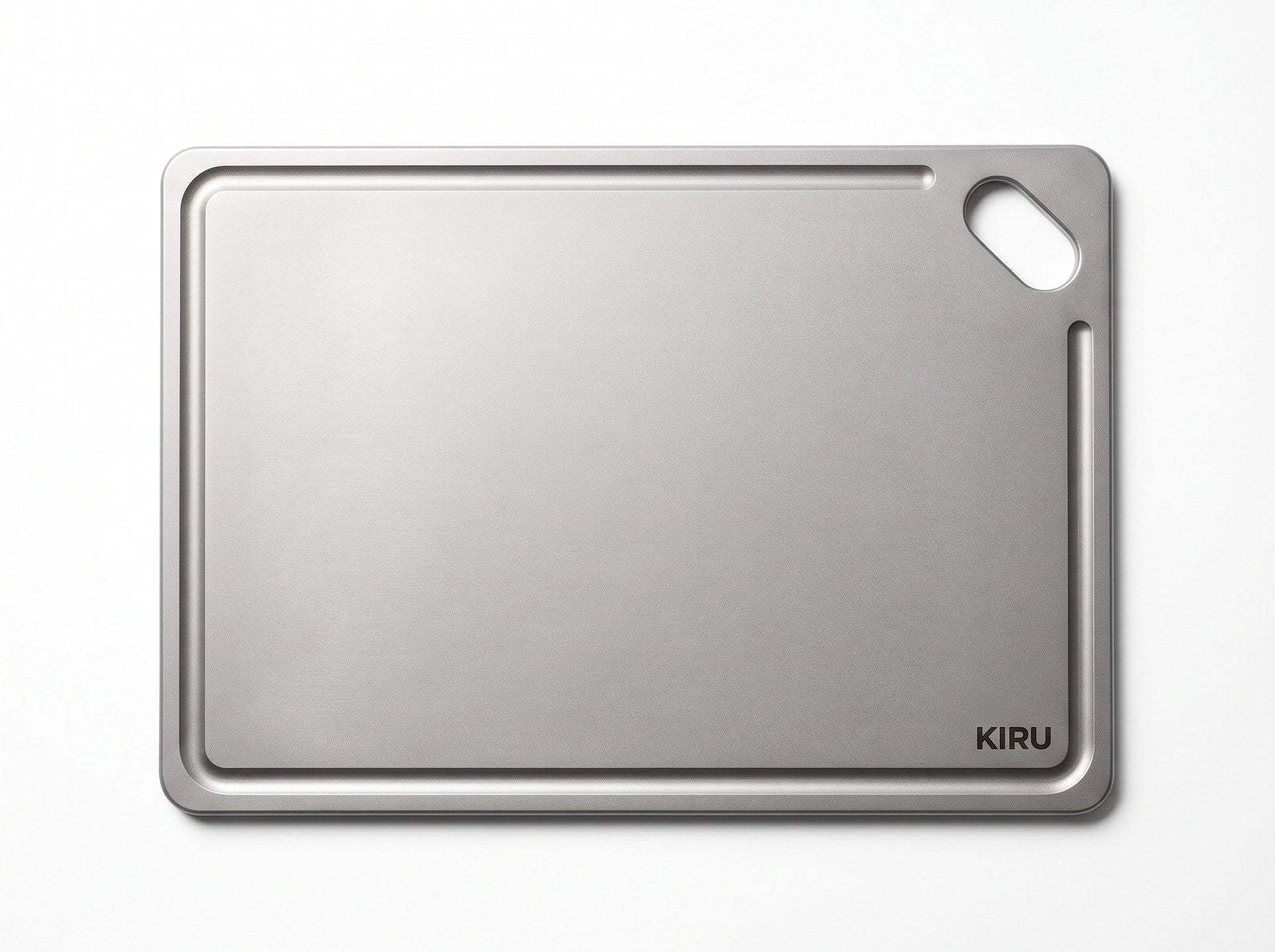
- No plastic in your food — solid food-grade titanium, nothing to flake or shed
- Clean in two seconds — no grain or grooves for raw meat juice to hide in
- Knives stay sharp — softer than your blade’s steel, so the edge isn’t ground down
- Meat on one side, vegetables on the other — double-sided with a juice groove
- The last board you buy — won’t warp, crack, stain, smell or rust
$98.00 $49.00 today
Money-back guarantee · Free US shipping
Since Diane’s story was first shared, Kiru has sold out twice. They have restocked, and the sale price is still showing on their page today, but they tell us stock is limited.
See Today’s Price & Stock →Morita’s closed on the last Saturday in September. Carol and I went to the final class. At the end Chef bowed to the room, and then he told us the thing he wanted us to take home was not a knife skill. It was to stop feeding our families our cutting boards.
You can keep using the board you have. You can keep replacing it every year and keep wondering where the grooves went. Or you can make the switch once. For me it was the easiest change I’ve made in that kitchen in forty years.
Reader stories reflect the writer’s own experience. Individual experiences vary.
Yadav H. et al. (2023). Cutting Boards: An Overlooked Source of Microplastics in Human Food? Environmental Science & Technology 57(22).
Gan L. et al. (2025). Simulated Microplastic Release from Cutting Boards and Evaluation of Intestinal Inflammation and Gut Microbiota in Mice. Environmental Health Perspectives 133(3–4).
Azizi-Lalabadi M. et al. (2019). Antimicrobial activity of titanium dioxide and zinc oxide nanoparticles. Scientific Reports 9.